
October 26, 2026
Your Comfort Zone Is Your Failure Zone
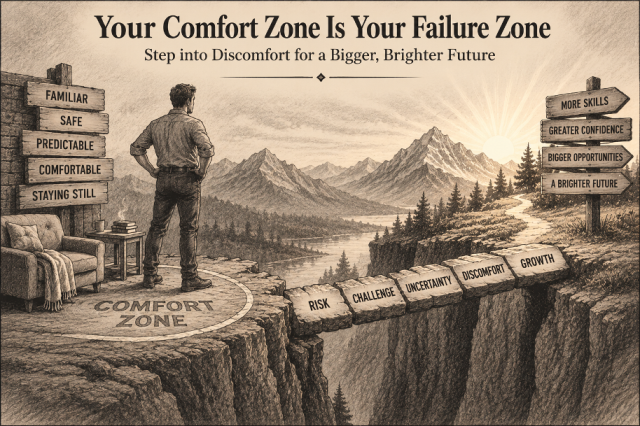
Most people think of “comfort” as a good thing. And in many situations, it is. Comfort can mean safety, familiarity, and the absence of immediate threats. But when it comes to growth, achievement, and personal transformation, comfort is often the silent saboteur. It’s the invisible line that separates who you are from who you could become. That is why your comfort zone is, in reality, your failure zone—not because staying comfortable makes you a failure, but because it guarantees that you never rise to your potential.
The Illusion of Safety
Comfort feels safe, but it’s misleading. When you avoid challenge, risk, or discomfort, you may feel in control, but you’re actually surrendering control to fear. The illusion of safety keeps countless people trapped in stagnant careers, unfulfilling relationships, and predictable routines. Meanwhile, the world changes around them. Skills become outdated. Opportunities pass by. Competitors leap forward. The longer you stay where you are, the more dangerous comfort becomes.
Growth requires movement. Comfort requires staying still. The two cannot coexist.
The Biology Behind Discomfort
Humans are hardwired to avoid discomfort. Our ancestors survived by recognizing and fleeing physical threats. Even today, our brains treat uncertainty as danger. Trying a new strategy, making a difficult call, or speaking in front of a group can trigger the same physical responses once reserved for sabertooth tigers. But in modern life, discomfort rarely signals danger—it signals possibility.
That flutter in your stomach before you give a presentation? That’s your brain preparing you for performance. The hesitation before a difficult decision? That’s your internal boundary stretching. Once you understand that discomfort is a sign of growth, not danger, you become dangerous—in the best possible way.
Comfort Causes Decline
Nothing in nature thrives in stillness. Muscles weaken when not used. Skills fade when not practiced. Businesses fail when not innovating. Likewise, people lose potential when they stop stretching.
When you choose comfort consistently:
- You stop learning.
- You stop developing resilience.
- You stop challenging assumptions.
- You stop taking opportunities that lead to breakthroughs.
What begins as simple comfort gradually becomes complacency. Complacency becomes stagnation. Stagnation, eventually, becomes regret.
Your comfort zone slowly transforms into your failure zone—not with dramatic collapse, but with subtle decay.
Discomfort Creates Mastery
Every valuable skill—leadership, communication, discipline, strategy, resilience—originates outside comfort. Consider any meaningful achievement in your life. Chances are, it required one of the following:
- Doing something for the first time
- Taking a risk
- Facing uncertainty
- Enduring temporary discomfort
- Challenging your own limitations
Growth is a stress response. The gym teaches this perfectly: resistance builds strength. Remove the resistance, and you remove the growth.
The same principle applies to your career, your relationships, and your personal dreams. If you never stretch the borders of your comfort zone, you never grow the capacity to achieve more.
The Cost of Staying Comfortable
People rarely regret the risks they took. They nearly always regret the ones they avoided.
Comfort has a hidden cost that only becomes visible over time:
- Missed opportunities: Promotions, partnerships, new ventures.
- Unrealized talent: Skills you never developed.
- Lost confidence: Self-belief erodes when you never challenge yourself.
- Shrinking dreams: The longer you wait, the smaller your ambitions become.
Eventually, your comfort zone becomes a cage built from your own fear of growth.
Expanding the Zone
The goal isn’t to eliminate comfort. It’s to expand it. Each time you push into discomfort, your comfort zone grows. What once felt intimidating becomes manageable. What once seemed impossible becomes normal. Confidence isn’t built by staying comfortable—it’s built through experience.
Start with small steps:
- Have the difficult conversation.
- Try a new skill.
- Make the bold call.
- Say yes to the opportunity that scares you.
- Stop avoiding the challenge you know you must face.
Courage isn’t the absence of fear—it’s acting despite it.
Your Future Self Lives Beyond Your Comfort Zone
Imagine the version of yourself you want to become: more skilled, more confident, more influential, more fulfilled. That version of you does not live in your current comfort zone. They exist beyond it—waiting for you to step into uncertainty.